
GUANGYUAN, China, June 9 (China News Service) — The waters of the Jialing River flow through a dramatic canyon where traces of ancient plank roads can still be seen on the sheer cliffs above. Within this narrow gorge, highways, railways, waterways, and ancient routes converge in the same space.
Standing on the ancient plank road, Gao Xiang, editor-in-chief of Germany's European Chinese News, closed his eyes to experience the unique atmosphere of Mingyue Gorge. “Closing my eyes, I listen to the whispers of the wind; tilting my head, I hear the river chanting,”Gao said, describing the moment with an impromptu verse.
On June 8, participants in the “2026 Overseas Chinese Media Tour of Sichuan and Chongqing — Focusing on the Chengdu-Chongqing Twin-City Economic Circle” visited Mingyue Gorge in Chaotian District of Guangyuan, Sichuan Province. There, they explored what is often described as a condensed history of Chinese transportation embodied in the gorge's remarkable “six roads in one gorge” landscape.
According to Ren Guiting, a guide at the Mingyue Gorge Scenic Area, the gorge—also known as Chaotian Gorge—has a history spanning more than 2,300 years. It is home to six transportation routes from different eras: the pre-Qin ancient plank road, the Jialing River waterway, the porters' bird path, the Jinniu Post Road, National Highway 108, and the Baoji–Chengdu Railway's second track.
These routes coexist within a single canyon, making Mingyue Gorge a unique “Museum of Chinese Transportation History” that showcases the evolution of transportation over the longest time span in the most concentrated and well-preserved form. The pre-Qin plank road carved into the cliffs is among China's earliest, most scientifically designed, and best-preserved ancient plank roads, with a large number of original support holes still visible today.
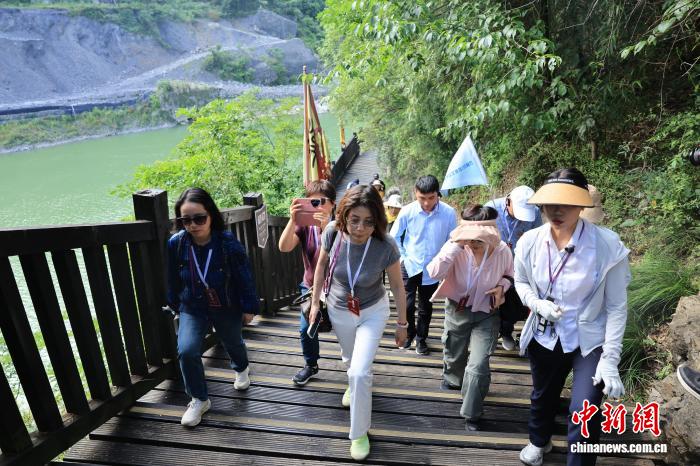
Participants in the 2026 Overseas Chinese-Language Media Sichuan-Chongqing Tour, themed on the development of the Chengdu-Chongqing Twin-City Economic Circle, visit Mingyue Gorge in Chaotian District, Guangyuan, Sichuan Province, on June 8. Photo by Zhang Lang
For the visiting overseas Chinese-language media representatives, what makes Mingyue Gorge particularly special is that, unlike a conventional museum displaying artifacts in glass cases, it presents transportation history directly within the natural landscape. “With cliffs this steep, how did workers even get up there?”wondered Tang Yongbei, president and editor-in-chief of Australia's Tasmanian Chinese Herald.
In her view, Mingyue Gorge allows visitors to witness not only the transformation of transportation methods through changing spatial landscapes, but also the enduring efforts of ancient people to connect regions separated by mountains and rivers. “It's truly breathtaking. The fact that ancient people overcame so many difficulties to build these plank roads demonstrates their determination to improve transportation,” Tang said.
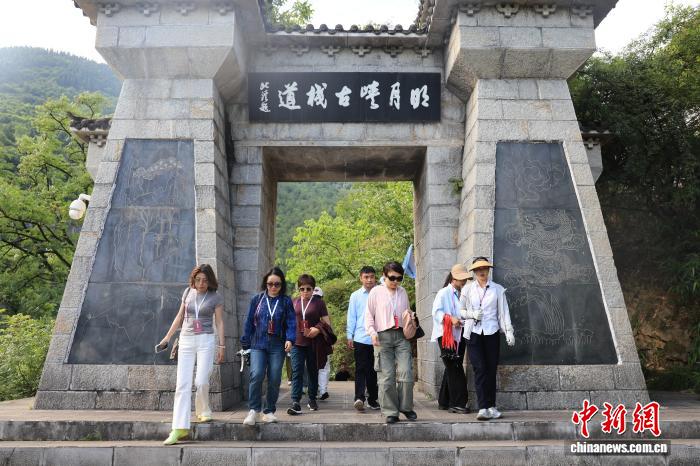
Participants in the 2026 Overseas Chinese-Language Media Sichuan-Chongqing Tour, themed on the development of the Chengdu-Chongqing Twin-City Economic Circle, visit Mingyue Gorge in Chaotian District, Guangyuan, Sichuan Province, on June 8. Photo by Zhang Lang
Located at the junction of Sichuan, Shanxi, and Gansu provinces, Guangyuan has long served as a key gateway into Sichuan from northern China. Chaotian District, where Mingyue Gorge is situated, developed because of transportation and owes much of its historical significance to its role as a strategic passageway. Ren noted that for centuries, merchants, soldiers, and travelers passed through the gorge. While modes of transportation evolved over time, the pursuit of connectivity remained unchanged.
From the old saying “The roads to Shu are harder than climbing to heaven” to today's modern transportation network, the six routes within Mingyue Gorge serve as six timelines, recording the development of transportation technology, regional exchanges, and social life.
For modern visitors, a walk through the gorge offers not only a glimpse of the ingenuity of ancient builders who carved roads into mountainsides, but also an understanding of how modern transportation continues to reshape development in mountainous regions.
“The people of Sichuan carved pathways where none seemed possible, creating a link between history and the future,”said Sun Yumei, vice president of Romania's European Chinese Newspaper. “Building roads along such precipitous cliffs is proof of the perseverance, courage, and wisdom of the people of Sichuan. Their indomitable spirit deserves to be carried forward.”